Saturday, August 25, 2018

August 1, 2018 - Visited Middle of the World

Our itinerary called for the visit of Middle of the World (Ciudad Mitad del Mundo) today. The grounds contain the Monument to the Equator, which highlights the exact location of the Equator (from which the country takes its name).  Over the years, countless tourists have had their pictures taken straddling the line drawn down the center of the east-facing staircase and across the plaza. There is a yellow line divides the 2 hemispheres. One can stand on the yellow line with one foot in north hemisphere and the other foot in south hemisphere.  We did just like thousands of other tourists and took a lot of photos at this spot.
In addition, the LNASUR (Union of South American Nations) headquarter is located next to this monument.
Then, we got back to Quito to visit the El Panecillo which is a 200-meter high hill of volcanic organ located between southern and central Quito. In 1976, the Spanish artist Agustin de la Herran Matorras was commissioned to build a 45-meter tall stone monument of Madonna.  The virgin stands on top of a globe and has wings.  Locals claim that she is the only one in the world with wings like an angel.
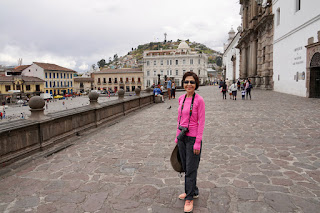
Then, we had a walking tour to visit the Quito Old Town which is also known as Centro Historico. After numerous of earthquakes through the Quito’s old town, it is the best preserved historic centre in Latin America.  Quito Old Town was, together with the historic centre of Kraków in Poland, the first to be declared World Heritage Site by UNESCO on 18 September 1978.

First we walked by the Presidential Palace to visit the most magnificent church in Quito; Iglesia la Compañia de Jesus. Iglesia la Compañia de Jesus is among the best-known churches in Quito because of its large central nave, which is profusely decorated with gold leaf, gilded plaster and wood carvings. Unfortunately, there is no photo allowed inside this church.
Then we visited Iglesia de San Francisco which has the distinction of being the largest architectural ensemble among the historical structures of colonial Latin America. The Church houses the city's beloved Virgin of Quito.
After we got back to hotel, we did venture out to the nearby market for souvenir shopping.  We all decided to stay in the hotel for dinner.  Metropolitan Tour (the Ecuador local tour contracting company) did ask the hotel staff to provide a small cake to celebrate Corrina's birthday.

August 2, 2018 - Flew to Baltra Island of Galapagos and embarked Santa Cruz II

We got up earlier again to fly to Baltra Island of Galapagos to start our Galapagos expedition on Santa Cruz II. We arrived Baltra Island around 11AM and had to take zodiac (rubber boat, they also referred it as banga) to reach Santa Cruz II docked in the middle of the ocean.  Santa Curz II is one of the larger ships which provide cursing expeditions in Galapagos.
The three decks of Santa Cruz II hosts 90 guests throughout 50 modern cabins. On Santa Cruz II, each expedition will be accompanied by knowledgeable guides. Activities range from daily land expeditions to a host of aquatic activities including ocean kayaking, snorkeling and glass bottom boat.  They divided all guests into different groups with assigned guides. All of us were grouped into the Frigates Group with Eddie as our assigned guide.
In the afternoon, we had our first dry landing to Cerro Dragon (Dragon Hill on Santa Cruz Island) to walk on lava rocks to see marine iguanas, and land iguanas.  The trail in Dragon Hill is one of the longest in Galapagos, wends its way through a desert-like landscape, passing through forests of cactus and fragrant Palo Santo trees. On the way, we spotted many marine iguanas and several land iguanas.  This was our first encounter of Galapagos animals, andt we had a lot of photo opportunities.

August 3, 2018 - Galapagos Cruise: Isabela Island & Fernandina

Our ship sailed overnight to Punta Vicente Roca of Isabela Island.  Today's activities included zodiac ride and snorkeling. We all chose the zodiac ride to view Galapagos animals.  The zodiac took us close to the cliff with chances of seeing marine iguanas, Galapagos fur seals, green sea turtles, blue-footed boobies, brown pelicans, brown nodes, Galapagos penguins, flightless cormorants, lava gulls and Sally lightfoot crabs.  It was our first experience of seeing so many different animals in close distance.  We were all very excited and took many photos of these wonderful animals.
Then we got onto the glass bottom boat to see underwater animals.  We saw some tortoises and yellow-tail fishes.  Since the glass bottom on the boat did not provide a clear view of underwater animals, we ended up looking for animals on the shore.  We got a chance to see a couple of frigatebirds.
In the afternoon, our ship sailed to Punta Espinoza of Fernandina Island. We got the chance of seeing a lot more marine iguanas, Galapagos fur seals, Sally light-foot crabs, green sea turtles, flightless cormorants and lava lizards.  Many of the marine iguanas can be seen swimming and looking for food under the water, and swimming up to shore. The iguanas can stay under the water for up to an hour as they are always in search of algae. Their body temperature can drop down some 20°F while they swim and look for food, which causes them to lay out on the lava rock as they digest their food, and for a quick warm-up.  This is the place where people mentioning about "iguanas everywhere in Galapagos".  
A mother Galapagos fur seal and her baby were nearby playfully swimming, and did a show for us.  We also saw a lot of other animals in action. 
Many people visit Punta Espinoza in Fernandina Island for the abundance of lava rocks that are available due to the presence of one of the most active volcanoes in the world. The volcano is considered to be the youngest in the Galapagos, with its last eruption taking place in April 2009.
After we got back to ship, we all attended the photograph session offered by the ship photographer and we were able to pick up a few tips of take interesting photos.

August 4, 2018 - Galapagos Cruise: Santa Cruz Island

We had a dry landing to visit the Santa Cruz Island.  Santa Cruz is the second largest island after Isabela. Its capital is Puerto Ayora, the most populated urban center in the islands. On Santa Cruz there are small villages, whose inhabitants work in agriculture and cattle raising. 
The first stop was the Charles Darwin Research Station which is a biological research station operated by the Charles Darwin Foundation. It is located on the shore of Academy Bay in the village of Puerto Ayora. The Charles Darwin Research Station has almost 60 years of experience conducting applied scientific research for the conservation of the Galapagos Islands. As official advisors to the Government of Ecuador, they have a long history of collaboration with the Galapagos National Park Directorate (GNPD) and other local, national and international institutions.
The Galapagos Islands are currently facing many challenges including invasive species, climate change, illegal fishing, increasing population growth and tourism. In addition, there are still considerable gaps in what we know about Galapagos biodiversity, how Galapagos ecosystems function and where management interventions should be carried out. They are also researching ways to restore degraded ecosystems and recover populations of key species that are in decline. For instance, through their research, now they can control the birth rates of male or female tortoises by temperature control.  There were a lot captive tortoises ranging from babies to giant adults there.  Our guide also shared the story of the famous tortoise Lonesome George and the the hero Diego from San Diego.
After we visited Charles Darwin Research Station, we went to a private sugar cane farm.  There was an option of riding mountain bike to the farm vs riding the bus.  Several of us chose to ride mountain bike for about the later part of the 4KM.  We were warned that there are uphill rides, however, we did not know that it has more uphills than we expected.  It was hard on riding mountain bike to the sugar cane farm.  But it was fun.  
In the sugar cane farm, the owner demonstrated the way he makes moonshine.  We tried the 112 proof moonshine and it was good.  He sales $5 per bottle, and several of us bought it for souvenir. 
Then we visited a lava tunnel.  When the lava flow ceased, the molten lava inside the flow kept going, emptying out of the solidified skin and then it formed a lava tunnel.
After lunch at Manzanillo Restaurant, we visited a Primica to see the giant tortoises in their natural habitat.  
Then our guide left us in downtown of Puerto Ayora and gave us free time to either walking around the town or getting back to ship via zodiac.